

Marine Vehicles / Titanium


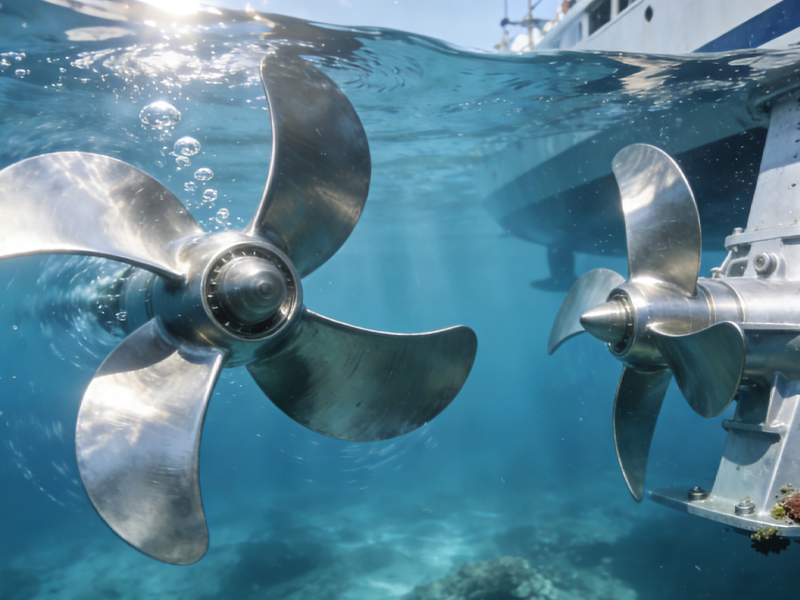
The application of titanium in marine vessels is indeed a technological highlight. With its advantages such as lightweight, high strength, corrosion resistance, and non-magnetic properties, it is changing the design and performance of ships. Specifically:
I. Core Advantages
Lightweight: Titanium’s density is only 57% that of steel, significantly reducing hull weight while maintaining the same strength, thus increasing speed and load-bearing capacity. For example, the use of titanium alloy frames in polar icebreakers has improved structural stability by 30% and reduced foundation construction costs.
High Strength: Titanium alloys have high strength and good toughness, capable of withstanding high-intensity impacts. For example, titanium alloy propellers can solve the problem of cavitation corrosion, reducing maintenance costs by 35%.
Corrosion Resistance: The dense oxide film formed on the surface of titanium resists chloride ion corrosion, and the lifespan of seawater cooling system pipes is three times that of stainless steel. In the South China Sea, North China Sea, and East China Sea, the corrosion rate has been almost zero over 16 years.
Non-magnetic: Titanium is a paramagnetic material, which will not interfere with the fuses of magnetic mines or torpedoes, improving the stealth capabilities of submarines.
II. Specific Applications
Ship Structure: Titanium alloys are used to manufacture hull frames, pressure hulls, etc., reducing hull weight and improving structural stability. For example, after adopting titanium alloy frames, the structural stability of Japanese coastal buildings improved by 30%.
Pipeline Systems: Titanium alloys are used to manufacture seawater cooling system pipes, sea passage pipes, etc., exhibiting strong corrosion resistance and a long service life. For example, an American company used seamless titanium alloy pipes to create nearly 500m long vertical shaft pipes for offshore drilling platforms.
Propulsion Components: Titanium alloys are used to manufacture propellers, propeller shafts, etc., resisting cavitation corrosion and improving propulsion efficiency. For example, after the Japanese torpedo boat “PT-10” switched to Ti-6Al-4V alloy, its shaft diameter was reduced by 600kg.
Acoustic Devices: Titanium has good sound transmission properties, making it the ideal material for shipboard sonar domes. For example, titanium alloy sonar domes can improve sonar detection accuracy.
III. Market Cases
- Japanese coastal construction: Widely uses titanium alloy cladding technology to effectively resist salt spray corrosion and reduce maintenance frequency.
- US SES-100A experimental submarine: The waterjet propulsion system uses industrial pure titanium castings and Ti-6Al-4V alloy forgings.
- Japanese torpedo boat “PT-10”: After switching to Ti-6Al-4V alloy, the shaft diameter was reduced by 600 kg, and the weight was reduced by 600 kg.
- Soviet ALFA-class nuclear submarines: The pressure hulls are all made of titanium alloy, with each submarine using 3500 tons of titanium and a diving depth of 900 meters.
IV. Future Trends
With technological advancements and increasing demands for environmental protection and energy conservation, the application of titanium alloys in marine vessels will become more widespread. In the future, titanium alloys are expected to achieve breakthroughs and innovations in more fields. For example, in the field of new energy ships, titanium alloys can be used in the thermal insulation treatment of battery packs; in the field of deep-sea exploration, titanium alloys can be used to manufacture the pressure hull of deep-sea submersibles, improving diving depth and safety.